








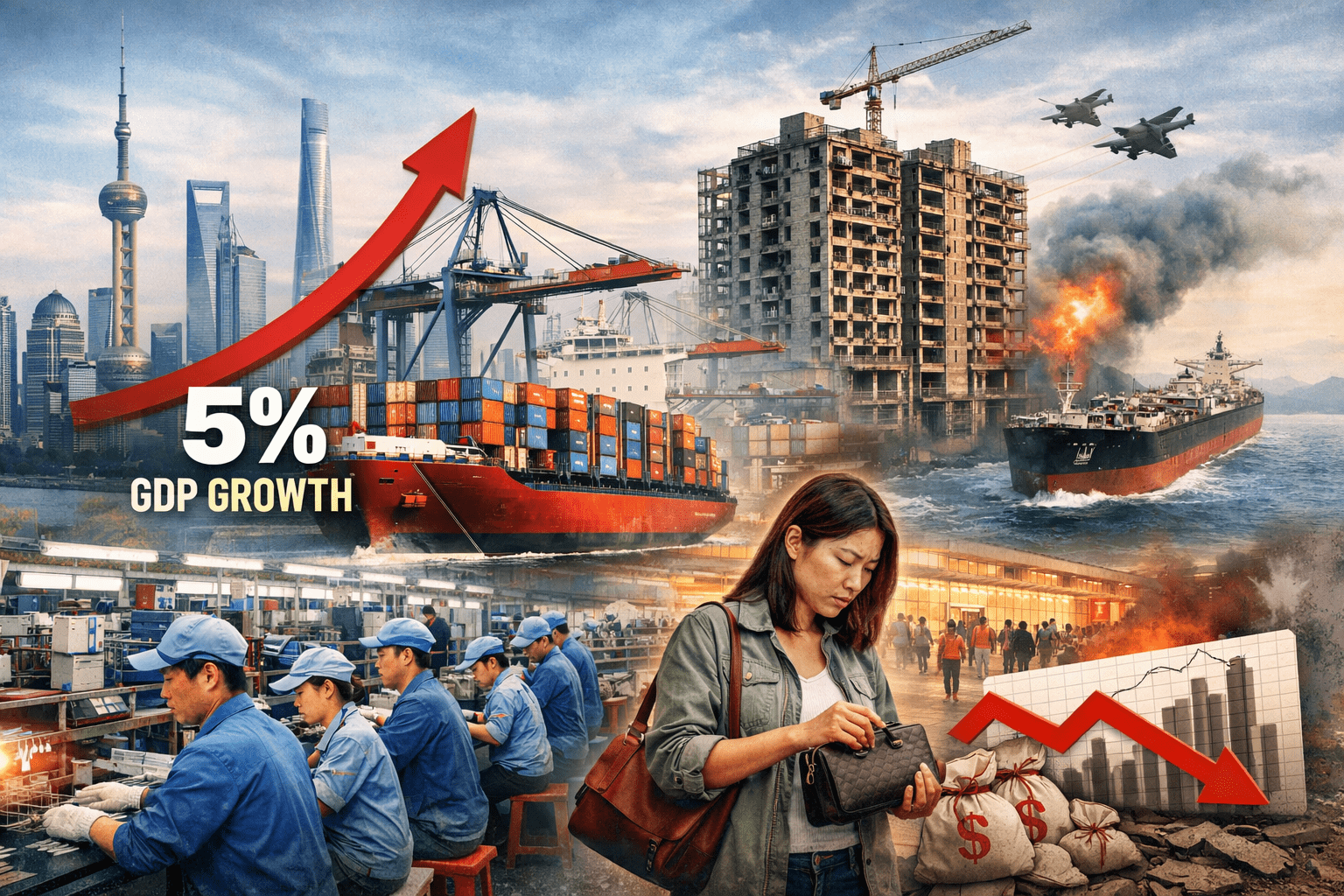
China’s economy expanded by 5.0% year-on-year in the first quarter of 2026, exceeding expectations and signaling resilience despite growing global uncertainty and domestic challenges.
Data released by the National Bureau of Statistics (NBS) showed the growth rate improved from 4.5% in the previous quarter, beating analysts’ forecasts of 4.8%. The performance places the world’s second-largest economy within its official annual growth target of 4.5% to 5%.
However, analysts caution that the headline figure masks deeper structural concerns—particularly weak consumer demand and ongoing stress in the property sector.
Exports and Industry Lead Growth
The first quarter expansion was largely driven by strong exports and industrial output, highlighting China’s continued reliance on external demand.
- Industrial production rose 6.1% year-on-year in Q1
- March output grew 5.7%, slightly above expectations
- Exports remained a key growth pillar despite recent slowdown
In contrast, retail sales grew only 2.4% in the first quarter, underscoring an imbalance between production and consumption.
Economists note that China’s recovery remains export-led, raising concerns about sustainability amid rising global risks.
Consumer Demand Remains Weak
Domestic consumption continues to lag, reflecting cautious household spending:
- Retail sales increased just 1.7% in March, missing forecasts
- Growth slowed from 2.8% in February
- Auto sales weakened, signaling hesitation on big purchases
While sectors like electronics, gold, and jewelry saw temporary boosts due to holiday demand and government incentives, broader consumer confidence remains subdued.
Property Sector Continues to Drag

China’s real estate crisis deepened further in early 2026:
- Real estate investment fell 11.2% as of March
- Compared with a 9.9% decline a year earlier
At the same time, fixed-asset investment rose only 1.7%, below expectations, reflecting weak private sector confidence.
The prolonged downturn in housing—once a major growth engine—continues to weigh on the broader economy.
Iran War Adds External Pressure
Global uncertainties have intensified due to the ongoing conflict in the Middle East, particularly the Iran war, which has disrupted energy markets and trade flows.
- Rising oil prices have increased production costs
- Shipping disruptions, especially around key routes, are affecting logistics
- Export growth slowed sharply to 2.5% in March, down from 21.8% earlier
As the world’s largest oil importer, China is especially vulnerable to energy price fluctuations.
Inflation Signals Emerging
In a notable shift, factory-gate prices rose in March for the first time in over three years. This indicates:
- Rising input costs, particularly energy
- Pressure on manufacturers’ profit margins
- Potential inflationary effects in the coming months
Outlook: Growth Likely to Slow
Despite a strong start, economists expect growth to moderate in the coming quarters due to:
- Weak domestic demand
- Property market instability
- Global geopolitical tensions
China’s leadership has maintained a cautious 4.5%–5% growth target for 2026, reflecting these uncertainties.
International institutions have also lowered expectations, warning that global economic disruptions—especially from the Middle East conflict—could weigh further on China’s export-driven model.
Conclusion
China’s first-quarter performance highlights a resilient but uneven recovery. While exports and industry continue to support growth, weak consumer demand and external risks pose significant challenges.
The coming months will be critical in determining whether China can rebalance its economy—or remain dependent on global demand in an increasingly uncertain world.