








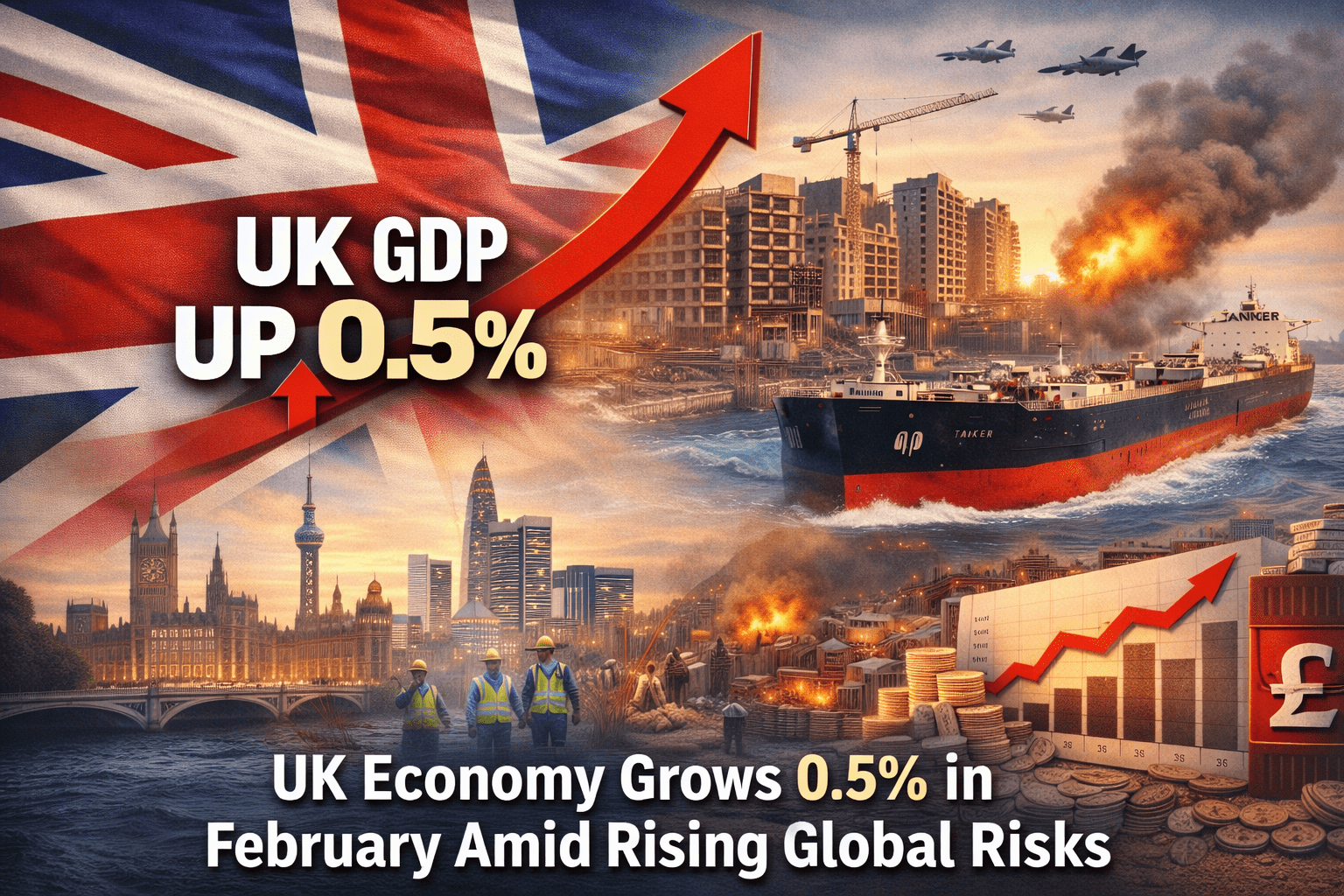
The United Kingdom’s economy delivered a stronger-than-expected performance in February 2026, offering a brief boost of optimism before global tensions cast a shadow over the outlook.
According to preliminary figures from the Office for National Statistics (ONS), the UK’s gross domestic product (GDP) expanded by 0.5% month-on-month in February, far surpassing economists’ expectations of just 0.1%. The data also showed that the economy grew by 0.1% in January, revised upward from earlier estimates that suggested no growth.
This unexpected acceleration indicates that the UK economy had begun the year on a firmer footing, supported by improvements across several key sectors. However, analysts caution that the data reflects a period before the escalation of geopolitical tensions in the Middle East, meaning the positive momentum may not be sustained.
Growth Driven by Key Sectors

February’s growth was broad-based, with gains recorded across services, production, and construction.
The services sector, which accounts for more than three-quarters of the UK economy, grew by 0.5%, marking its fourth consecutive monthly increase. This steady expansion reflects improved activity in retail, hospitality, and professional services, suggesting that consumer-facing industries were regaining some strength.
At the same time, production output also increased by 0.5%, indicating resilience in manufacturing and industrial activity. The construction sector stood out with a 1.0% rise, driven by infrastructure projects and building activity.
Together, these gains point to a relatively balanced recovery, with multiple sectors contributing to the overall expansion. Economists described the growth as “sizeable,” particularly given the weak expectations heading into the month.
Iran War Casts Shadow Over Outlook

Despite the encouraging data, the economic outlook has shifted dramatically due to the outbreak of the Iran war at the end of February. The conflict has disrupted global energy markets, leading to a sharp increase in oil and gas prices.
For the UK, this presents a significant challenge. As a net importer of energy, the country is particularly vulnerable to rising global prices. Higher energy costs can feed directly into inflation, increase business expenses, and reduce household purchasing power.
The International Monetary Fund (IMF) has already warned that the UK could face the largest economic hit among major advanced economies due to the ongoing crisis. It has cut its 2026 growth forecast for the UK to 0.8%, down from a previous estimate of 1.3%.
Inflation Pressures and Interest Rate Uncertainty

The surge in energy prices is expected to push inflation higher in the coming months. Economists now predict that inflation could rise to 3.3% in March, compared to 3% in February.
This shift complicates the outlook for monetary policy. Before the escalation of the conflict, the Bank of England had been expected to begin cutting interest rates as inflation gradually moved toward its 2% target.
However, the renewed inflationary pressures have changed expectations. Markets are now pricing in the possibility of interest rate hikes later in 2026, as policymakers attempt to keep inflation under control.
At the same time, the central bank faces a delicate balancing act. Raising rates too aggressively could slow economic growth further, while failing to act could allow inflation to remain elevated.
Outlook: Growth Likely to Slow
Looking ahead, economists expect the UK economy to face increasing headwinds. Higher energy costs are likely to weigh on both consumers and businesses, reducing spending and investment.
Consumer confidence could weaken as living costs rise, while businesses may delay expansion plans due to uncertainty about future demand and costs. There are also concerns that the labor market could soften if economic conditions deteriorate.
Many analysts believe that the strong performance in February may represent a temporary peak, with growth slowing in subsequent months as the impact of global events becomes more apparent.
Conclusion
The UK economy’s 0.5% growth in February 2026 marks a significant upside surprise and highlights the underlying resilience of key sectors. However, the timing of the data—just before a major geopolitical escalation—means that it offers only a partial picture of the current economic landscape.
With rising energy prices, increasing inflation, and heightened global uncertainty, the outlook for the UK economy has become far more challenging. The months ahead will be crucial in determining whether the economy can maintain its momentum or face a period of slower growth and renewed pressure.