
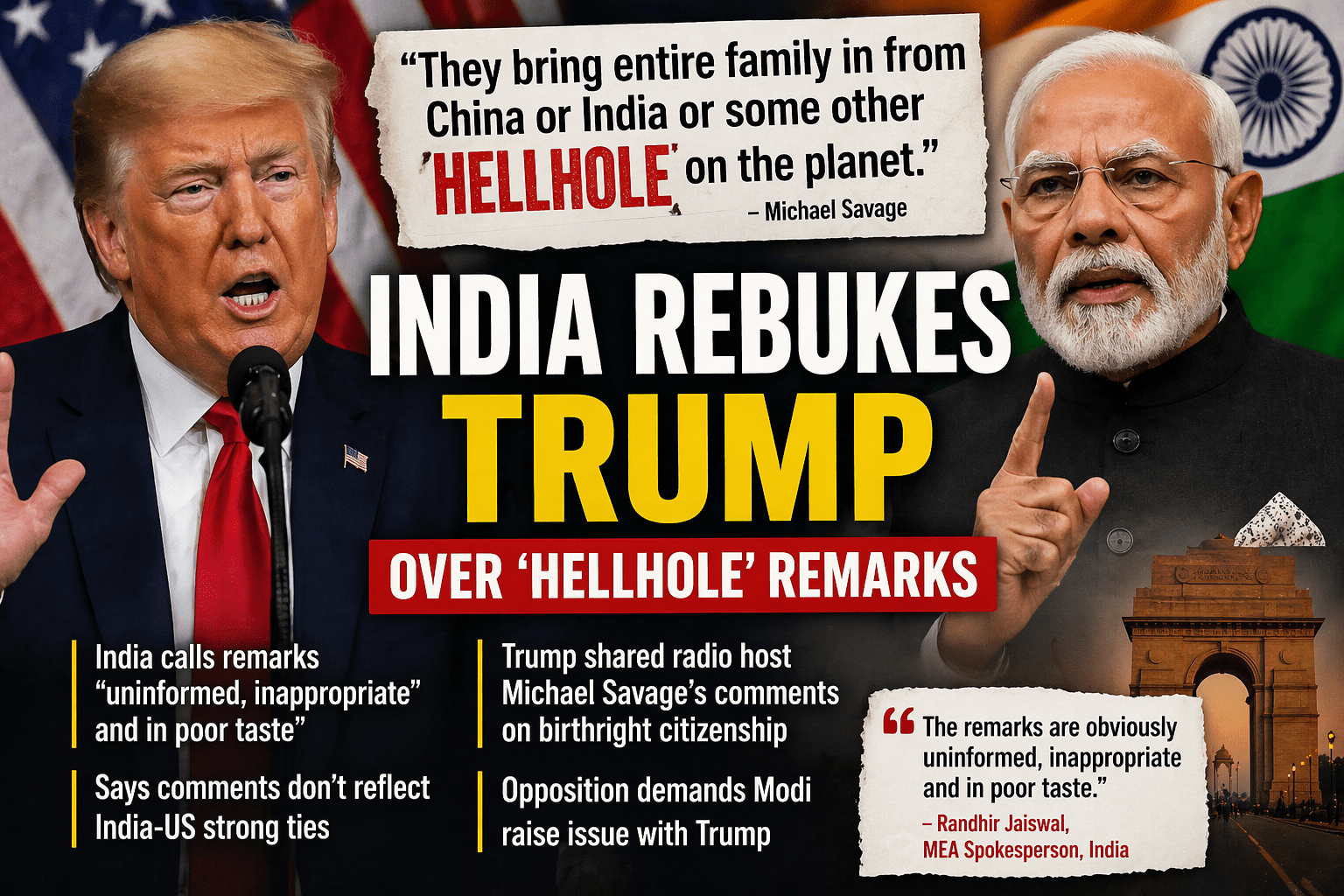
India has strongly criticized remarks shared by U.S. President Donald Trump that described the country as a “hellhole,” calling them “uninformed, inappropriate, and in poor taste.”
The controversy erupted after Trump reposted comments made by conservative radio host Michael Savage on his show The Savage Nation. The remarks were part of a broader discussion on birthright citizenship in the United States.
What Sparked the Controversy
The comments in question referred to immigration policies, with Savage stating that children born in the U.S. automatically gain citizenship and later bring families from countries like India and China, which he described using derogatory language.
Although Trump did not explicitly endorse the remarks, his decision to share the transcript on his social media platform added fuel to the controversy.
The issue comes at a sensitive time, as Trump’s administration continues to push for restrictions on birthright citizenship — a move currently facing legal challenges, including scrutiny from the U.S. Supreme Court.
India’s Strong Response
India’s Ministry of External Affairs issued a sharp rebuttal through spokesperson Randhir Jaiswal, who said:
“The remarks are obviously uninformed, inappropriate and in poor taste.”
He further emphasized that such statements do not reflect the true nature of India-U.S. relations, which are built on mutual respect and shared strategic interests.
The response underscores India’s intent to firmly counter narratives that undermine its global standing.
Diplomatic Balancing Act
Despite the backlash, the U.S. Embassy in New Delhi attempted to soften the situation, reiterating Trump’s earlier positive remarks about India:
“India is a great country with a very good friend of mine at the top.”
This highlights the complex nature of diplomatic ties between the two nations. While public rhetoric may create friction, both countries continue to maintain strong cooperation in areas such as trade, defense, and technology.
Relations between Trump and Narendra Modi have historically been warm, although recent trade tensions and tariff disputes have introduced some strain.
Political Reactions in India
The remarks also triggered strong political reactions within India. The opposition party, Indian National Congress, condemned the comments as “extremely insulting and anti-India.”
The party urged Prime Minister Modi to raise the issue directly with Trump and register a formal protest.
Broader Context: Immigration and Indian Diaspora
The controversy touches on a broader debate around immigration in the United States. Government data indicates that nearly 5.5 million people of Indian origin live in the U.S., making them one of the largest and most influential immigrant communities.
Indian-Americans play a significant role in sectors such as technology, healthcare, and entrepreneurship, contributing substantially to the U.S. economy.
What Lies Ahead
While the diplomatic fallout from this episode may be temporary, it reflects deeper tensions surrounding immigration policy, political rhetoric, and international perception.
As India and the United States continue negotiations on trade agreements and strategic cooperation, maintaining mutual respect in public discourse will remain crucial for sustaining their partnership.