






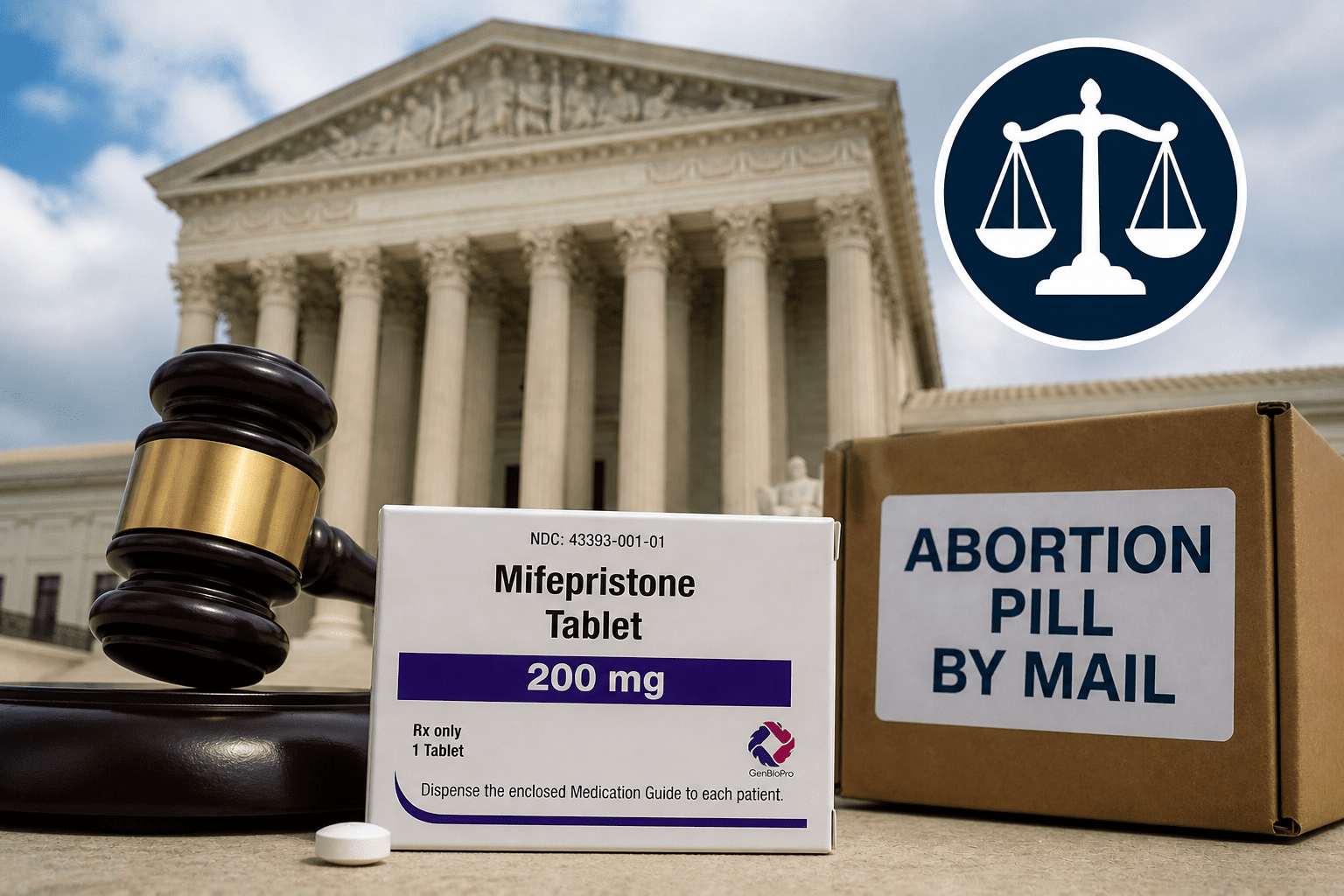

A pharmaceutical company has asked the Supreme Court of the United States to urgently block a lower-court ruling that restricts how a widely used abortion pill can be distributed, setting up another major legal battle over reproductive rights in the post-Roe era.
The request comes after the U.S. Court of Appeals for the Fifth Circuit ruled that the abortion drug mifepristone must be dispensed in person, effectively ending access through telehealth appointments and mail delivery for now.
Emergency Appeal Filed
Danco Laboratories, the maker of the brand-name version of mifepristone, filed an emergency application asking the Supreme Court to pause the ruling while the case proceeds.
The company argued that the appellate court’s decision is unprecedented and disrupts a system that has been in place for years. It warned that restricting access could create confusion among patients, providers, and pharmacies that have relied on telehealth-based distribution.
Background of the Case
The legal dispute stems from a lawsuit filed in Louisiana challenging the authority of the U.S. Food and Drug Administration, which had previously allowed mifepristone to be prescribed via telemedicine and shipped by mail.
The FDA first approved the drug in 2000, and over time loosened several restrictions, including removing the requirement that patients obtain the medication in person. Medical organizations have consistently cited extensive evidence supporting the drug’s safety and effectiveness.
Post-Roe Legal Landscape
Since the Supreme Court overturned Roe v. Wade in 2022, abortion access in the United States has increasingly shifted toward medication-based options.
In response, several states have enacted “shield laws” that protect healthcare providers who prescribe abortion pills across state lines, even to patients living in states with strict abortion bans. These laws have allowed continued access to abortion medication nationwide despite varying state restrictions.
At the same time, anti-abortion groups and Republican-led states have intensified legal challenges aimed at limiting access to these drugs, arguing that expanded distribution bypasses existing regulations.
Broader Implications
The Fifth Circuit’s ruling marks one of the most significant restrictions on abortion medication access since the fall of Roe v. Wade. Legal experts say the case could have far-reaching consequences, not only for abortion rights but also for how courts handle long-standing drug approvals.
Healthcare providers are already preparing for potential changes. Some have discussed shifting to alternative regimens using misoprostol alone, although it is generally considered less effective and may involve more side effects compared to the standard two-drug combination.
What Comes Next
It remains unclear when the Supreme Court will rule on the emergency request. However, the outcome could determine whether millions of patients can continue accessing abortion pills through telehealth and mail — or face new barriers requiring in-person visits.
The case is expected to be closely watched, as it represents a critical test of federal authority, judicial power, and the future of reproductive healthcare access in the United States.