
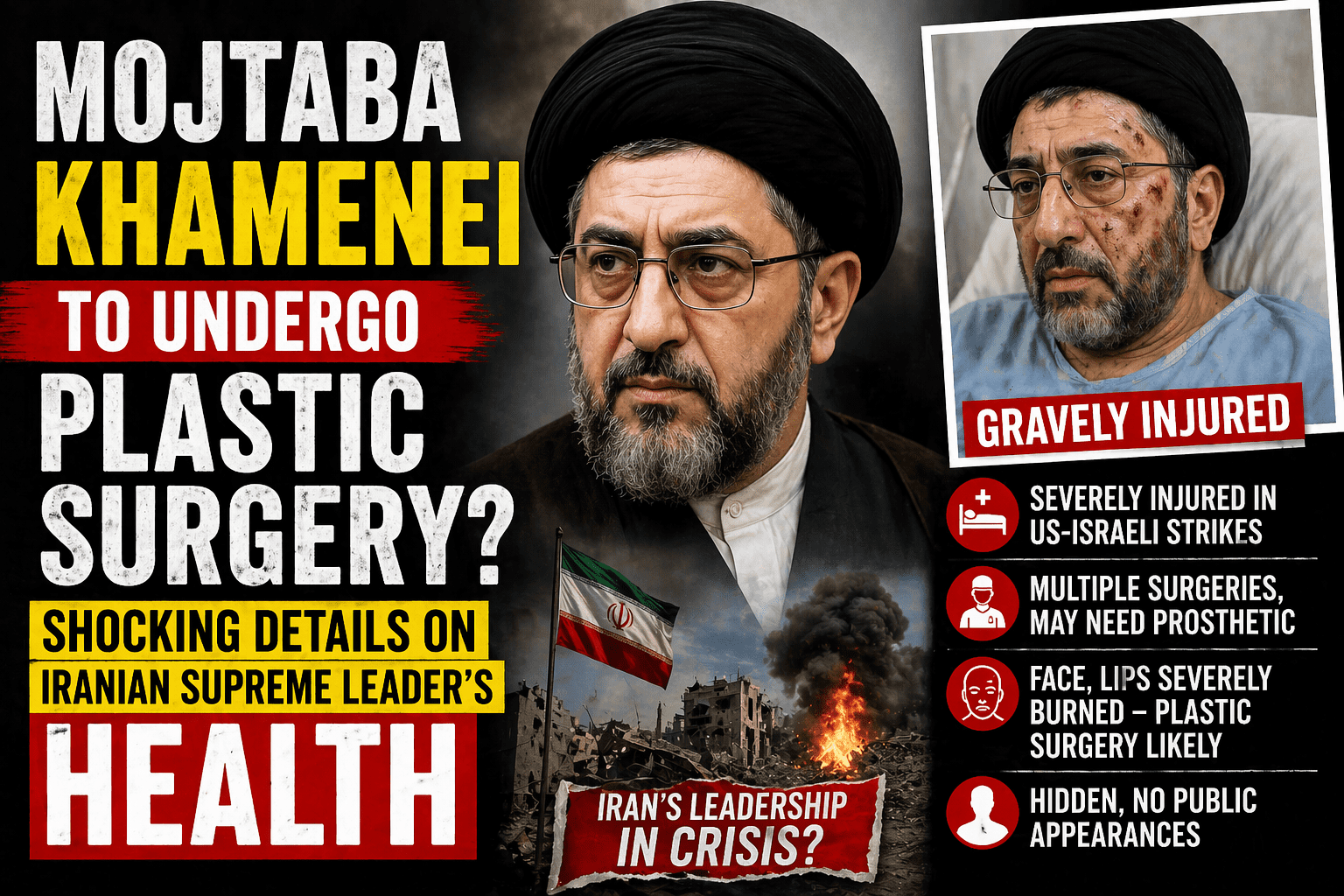
Fresh concerns have emerged over the health of Iran’s Supreme Leader, Mojtaba Khamenei, following reports that he was gravely injured during recent U.S.-Israeli strikes. While officials claim he remains mentally alert, his prolonged absence from public view has intensified speculation about his condition—and even raised questions about potential plastic surgery.
Reports of Severe Injuries After Airstrikes
According to multiple reports, including one by The New York Times, Khamenei sustained critical injuries during airstrikes that also reportedly killed his father, Ali Khamenei, along with other close family members.
Sources familiar with the situation indicate that:
- He suffered severe burns to his face and lips
- One of his legs underwent multiple surgeries and may require a prosthetic
- His hand was also injured and is gradually recovering
Doctors are said to be closely monitoring his condition at a highly secure and undisclosed location, with access described as “extremely limited.”
Possible Plastic Surgery and Recovery Challenges
Due to the extent of facial injuries, officials suggest that Khamenei may require plastic surgery as part of his recovery. His current condition reportedly makes it difficult for him to speak, further complicating any immediate public appearances.
Despite these physical challenges, reports emphasize that he remains “mentally sharp and engaged”, continuing to oversee matters of state through indirect communication.
Where Is Mojtaba Khamenei?
The exact location of the Iranian leader remains unknown. Security concerns are believed to be extremely high, with even senior officials and members of the Islamic Revolutionary Guard Corps avoiding direct contact to prevent detection.
Communication with Khamenei is reportedly conducted through:
- Handwritten messages
- Sealed envelopes
- Trusted courier networks traveling via multiple routes
This unusual system reflects both the sensitivity of his condition and fears of targeted strikes.
Leadership Concerns in Iran
Khamenei, who assumed power in March 2026, has not made a single public appearance since the conflict began. His absence has fueled concerns about leadership stability in Iran.
Reports suggest that decision-making authority has temporarily shifted to military generals, particularly within the Islamic Revolutionary Guard Corps, as the country navigates ongoing conflict and geopolitical pressure.
Why No Public Appearance Yet?
Officials indicate that Khamenei has deliberately avoided appearing in public to prevent projecting weakness during a critical phase of his leadership.
Instead, he has issued:
- Written statements via social media
- Messages broadcast through state television
Analysts say this strategy aims to maintain authority while he recovers, though it has also contributed to growing speculation and uncertainty both داخل Iran and internationally.
A Leadership Under Scrutiny
As the war continues and global attention remains fixed on Iran, questions about Khamenei’s health and ability to govern are likely to intensify.
While Iranian officials insist that he remains in control, the combination of severe injuries, secrecy, and reliance on intermediaries paints a picture of a leadership operating under extraordinary strain.
Conclusion
The reports surrounding Mojtaba Khamenei’s health highlight the fragile state of Iran’s leadership at a critical geopolitical moment. Whether he fully recovers—or how long he remains out of public view—could have significant implications for the region’s future stability.
For now, uncertainty continues to dominate the narrative, with the world closely watching for any signs of his return.