





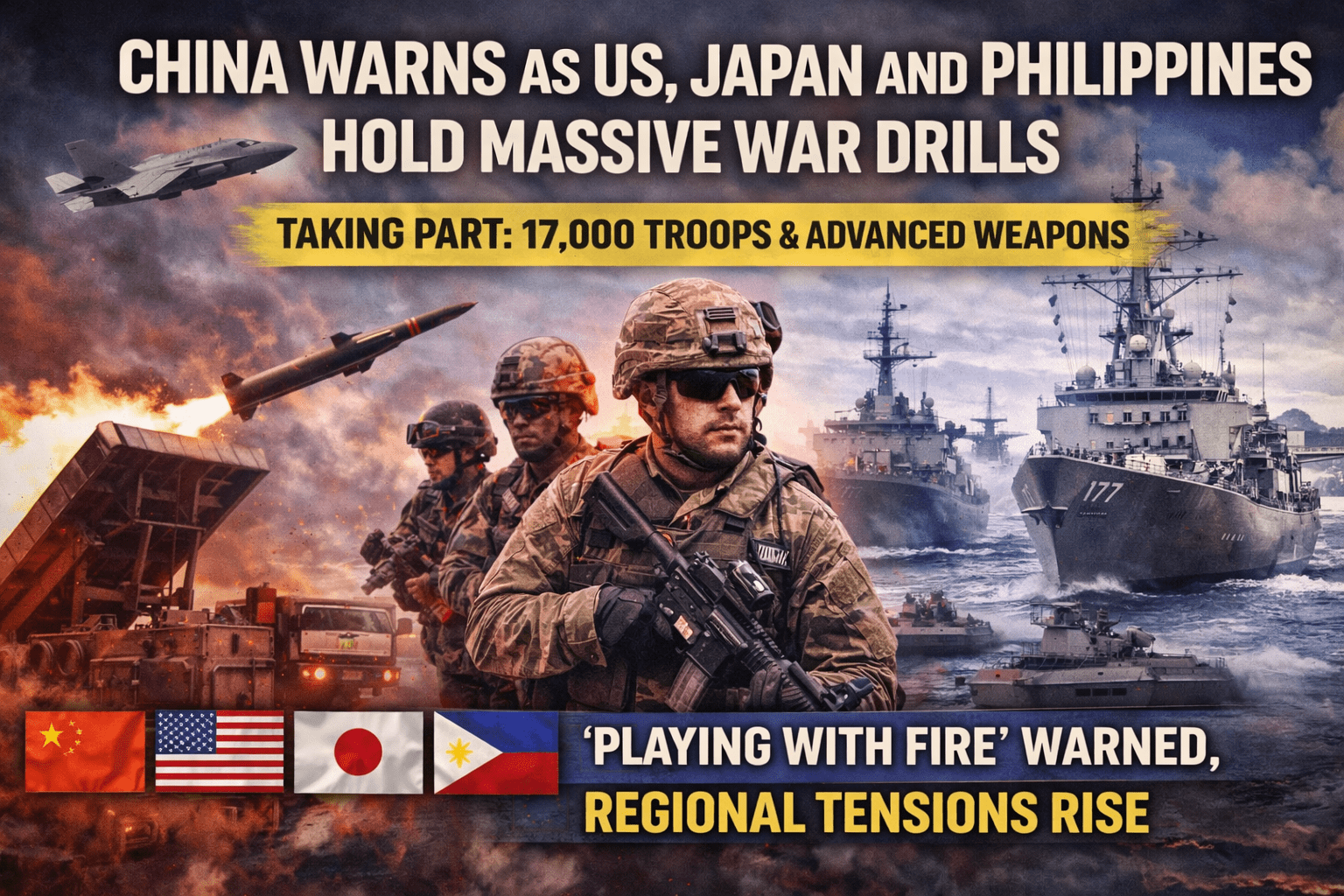
China has issued a strong warning to the United States, Japan and the Philippines as the three countries launched their largest-ever joint military exercises, escalating tensions in the Asia-Pacific region. The drills, involving more than 17,000 troops and advanced weapon systems, come at a time of heightened geopolitical uncertainty.
The annual “Balikatan” exercises, meaning “Shoulder to Shoulder,” are being conducted across key strategic areas in the Philippines, including regions facing the Taiwan Strait and the disputed South China Sea.
China Issues Sharp Warning
Beijing reacted swiftly to the launch of the drills, cautioning the participating nations against actions that could destabilise the region.
Chinese foreign ministry spokesperson Guo Jiakun stated that the Asia-Pacific region needs “peace and tranquility,” warning that forming military alliances in the name of security could amount to “playing with fire.”
China has repeatedly expressed concern over growing military cooperation between the United States and its regional allies, particularly in areas close to its territorial claims.
Over 17,000 Troops Take Part
This year’s Balikatan exercise is being described as the largest in its history.
- More than 17,000 military personnel are participating
- Around 10,000 troops are from the United States
- Approximately 1,400 Japanese personnel are involved
In addition, forces from Australia, New Zealand, France and Canada are also taking part, highlighting the expanding scale of international military cooperation in the region.
Philippine military chief General Romeo Brawner confirmed that the drills represent a significant upgrade in both size and capability.
Advanced Weapons and Live-Fire Drills
The exercises include a wide range of high-end military operations, including live-fire drills and missile testing.
Japan is expected to deploy its Type 88 cruise missile to sink a decommissioned World War II-era vessel off the northern coast of Luzon.
The United States will also showcase advanced systems such as the Typhon missile platform, underscoring its military capabilities in the Indo-Pacific.
These demonstrations are seen as a show of force aimed at enhancing deterrence amid growing tensions in the region.
Strategic Locations Raise Stakes
The drills are taking place in sensitive locations, including:
- Northern Philippines facing the Taiwan Strait
- Coastal areas near the South China Sea
Both regions have witnessed increasing confrontations, particularly between Chinese and Philippine forces over disputed maritime territories.
The choice of these locations has further intensified concerns in Beijing, which views such exercises as a direct challenge to its regional influence.
Global Context Adds to Tensions
The timing of the exercises is also significant. The drills coincide with ongoing geopolitical tensions in West Asia, including the fragile situation involving the United States, Iran and Israel.
Recent developments, such as the seizure of an Iranian vessel and uncertainty around peace talks, have added to global instability.
Despite these challenges, US officials have reiterated their commitment to maintaining a strong presence in the Indo-Pacific region.
US Reaffirms Commitment to Indo-Pacific
At the opening ceremony, US Lieutenant General Christian Wortman emphasized that Washington’s focus on the Indo-Pacific remains firm.
He stated that the United States’ “ironclad commitment” to the Philippines would continue, regardless of conflicts in other parts of the world.
This statement reinforces the strategic importance of the region in US foreign policy.
What It Means for the Region
The large-scale military exercises highlight the growing alignment between the United States and its allies in countering regional threats. However, they also risk further escalating tensions with China.
While the drills are officially described as defensive and aimed at improving coordination, Beijing’s strong reaction indicates that the situation remains highly sensitive.
Conclusion
The launch of the largest-ever Balikatan exercises marks a significant moment in Asia-Pacific geopolitics. With thousands of troops, advanced weapons, and strategic locations involved, the drills underscore rising tensions in the region.
As China warns against escalation and participating nations push ahead with military cooperation, the balance between deterrence and provocation will remain a key challenge in the coming weeks.