








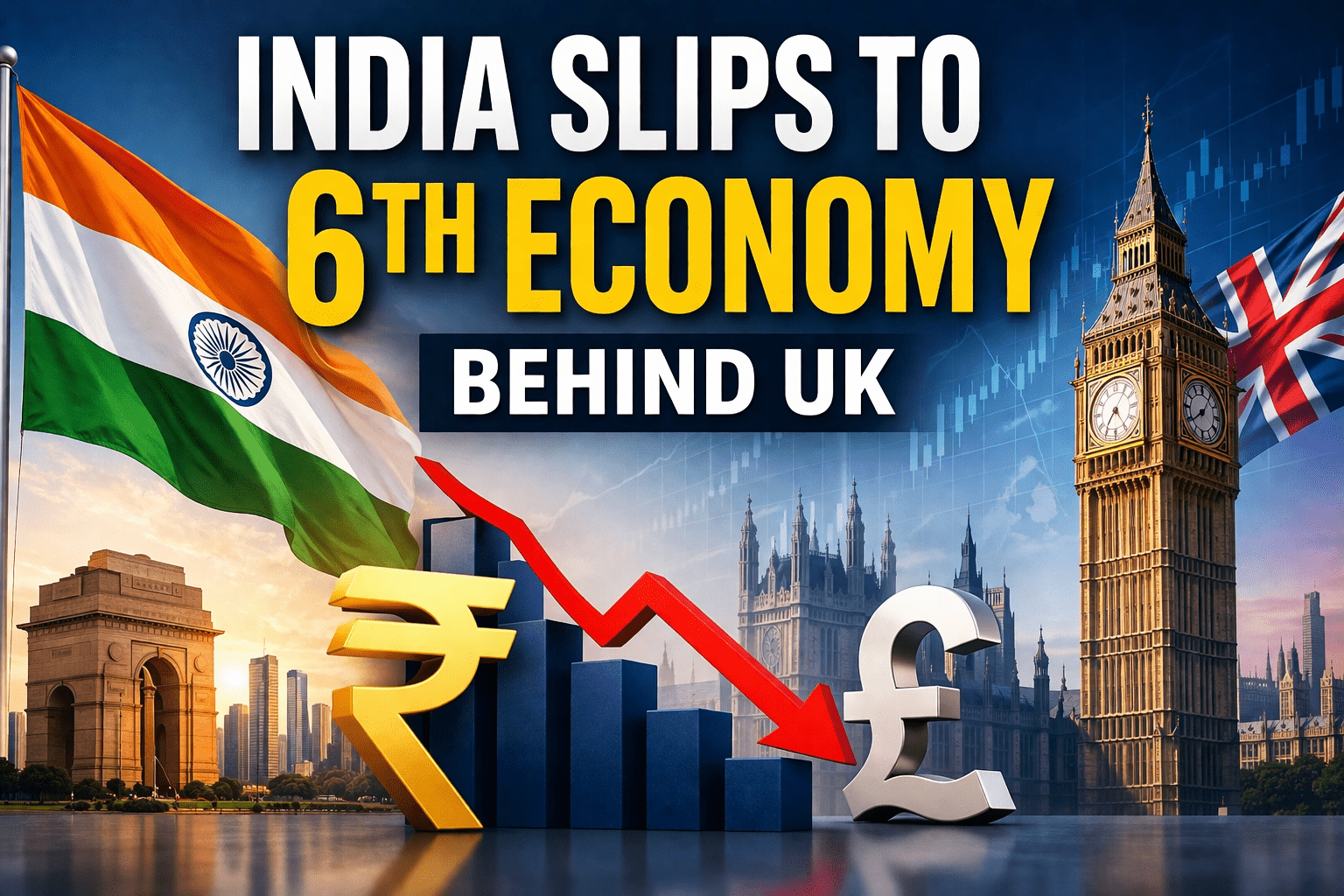
India’s position in the global economic rankings has taken a surprising turn. Despite being one of the fastest-growing major economies, the country has slipped to the sixth-largest economy, falling behind the United Kingdom. This shift has sparked debate, confusion, and concern—but the reality is far more nuanced than it appears.
Rather than signaling economic weakness, the drop is largely driven by technical and external factors, not a slowdown in India’s actual growth trajectory.
The Numbers Behind the Ranking
According to recent estimates, India’s GDP is projected to reach around $4.15 trillion in FY2026–27, while the UK stands slightly ahead at approximately $4.26 trillion. Just a year earlier, India’s GDP was around $3.92 trillion, trailing the UK’s $4 trillion.
This change has pushed India down one spot in the global rankings. However, it’s important to understand that these rankings are based on GDP measured in US dollars, not in local currency.
And that distinction changes everything.
The Real Reason: Rupee Depreciation
One of the biggest reasons for India’s slip is the weakening of the Indian rupee against the US dollar.
Over the past year, the rupee has depreciated significantly—from around ₹84–85 per dollar to nearly ₹90+ levels. When GDP is converted into dollars, a weaker rupee makes the economy appear smaller on the global stage—even if it is growing strongly in domestic terms.
In fact, India’s economy grew robustly in rupee terms, with nominal GDP rising consistently. But when translated into dollars, the depreciation reduces the overall value.
This is why economists stress that global rankings don’t always reflect real economic strength.
GDP Base Revision: A Statistical Reset
Another major factor is the revision of India’s GDP base year and methodology.
Earlier this year, the government updated the base year from 2011–12 to 2022–23, leading to a recalibration of economic data. As a result, nominal GDP estimates were revised downward—from around ₹357 lakh crore to ₹345.5 lakh crore.
This revision does not mean the economy shrank—it simply means that measurement methods improved, making estimates more accurate.
However, this statistical adjustment had a direct impact on India’s global ranking, lowering its apparent size compared to other economies.
Strong Growth Remains Intact
Despite the ranking drop, India continues to shine where it matters most—growth.
- IMF projects India’s real GDP growth at 6.5% in FY27
- Domestic estimates suggest growth of 7.4% in FY26
- India has recorded a compound annual growth rate of over 8.5% in recent years
These numbers make India the fastest-growing major economy in the world.
In contrast, developed economies like the UK are growing at a much slower pace. This means that while India may have temporarily slipped in rankings, its long-term trajectory remains strong and upward.
Why the UK Stayed Ahead
The United Kingdom’s position above India is not due to superior growth, but rather currency stability.
The British pound has remained relatively stable against the dollar, helping maintain the UK’s GDP value in dollar terms. Meanwhile, India’s currency depreciation created a gap.
This highlights an important reality:
👉 GDP rankings are influenced as much by currency movements as by economic performance.
Delayed Milestones, Not Derailed Growth
India was earlier expected to surpass Japan and become the fourth-largest economy by 2025. That timeline has now been pushed slightly forward.
According to updated projections:
- India may regain the 4th position by 2027
- It is expected to surpass Japan by 2028
- It could become the third-largest economy by 2031
These projections show that the current slip is temporary, not structural.
The Bigger Picture
India’s economic fundamentals remain strong:
- Rapid infrastructure development
- Expanding digital economy
- Rising domestic consumption
- Strong demographic advantage
Even global institutions continue to view India as a key driver of future global growth.
The recent ranking change is a reminder that headline numbers can sometimes be misleading. A country’s real economic health depends on productivity, growth, and long-term potential—not just its position on a global list.
Final Take
India slipping to the sixth-largest economy may sound alarming, but it is largely a statistical and currency-driven adjustment, not an economic setback.
With strong growth momentum, improving infrastructure, and favorable demographics, India remains on track to climb back up the global rankings in the coming years.
In simple terms:
India hasn’t slowed down—the numbers just got recalculated.