
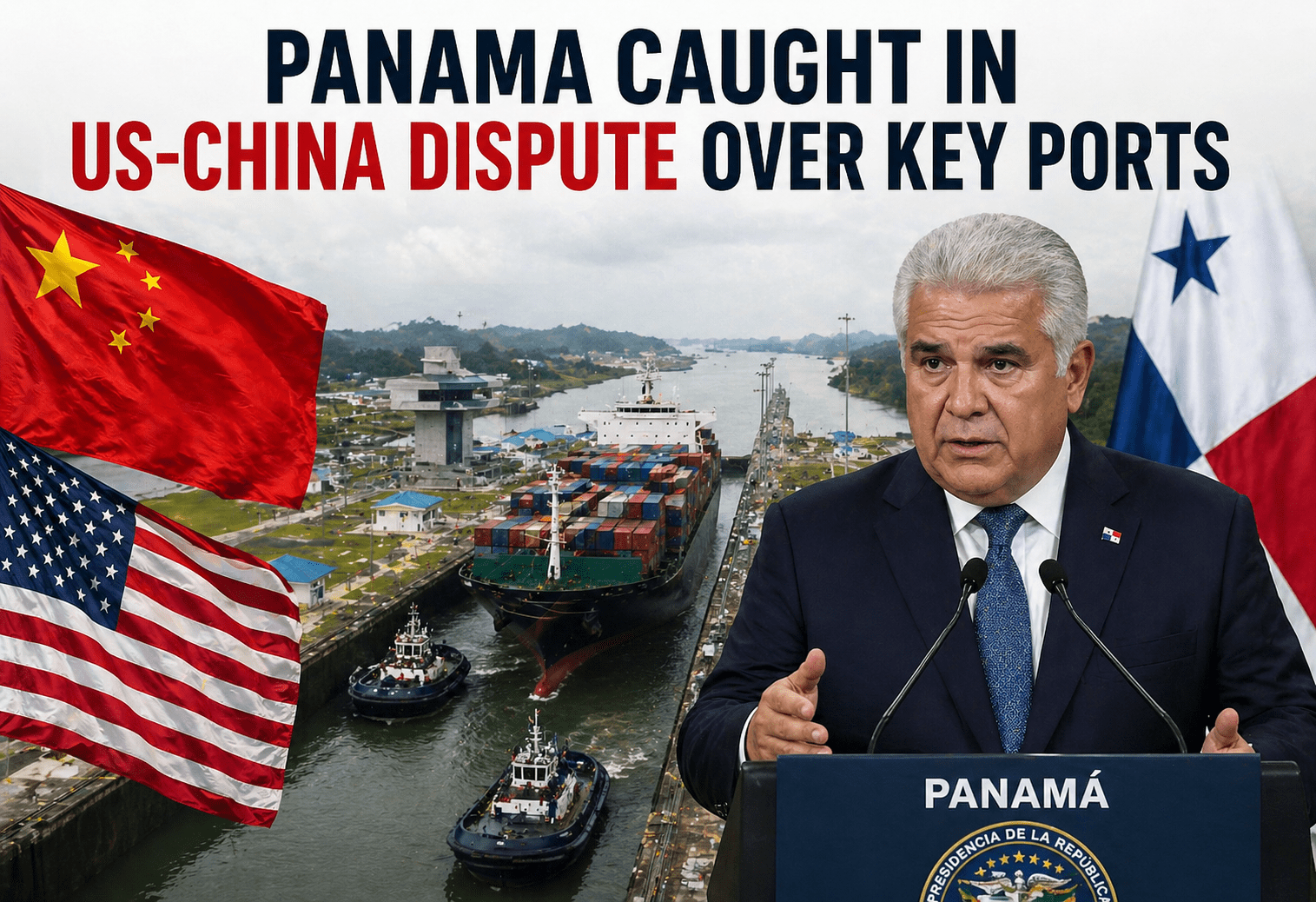
Panama has found itself at the center of rising geopolitical tensions between the United States and China, as a dispute over strategic port control intensifies.
President José Raúl Mulino acknowledged that the country is being pulled into a broader conflict between the world’s two largest powers, despite maintaining friendly relations with both sides.
Panama’s Position: Neutral but Impacted
Speaking at a press conference in Panama City, Mulino stated that Panama is being “carried along like a tide” by the dispute between the US and China.
While emphasizing that Panama continues to have a positive relationship with China, he clarified that the port disagreement is not a direct diplomatic conflict between the two nations.
Instead, the issue has been escalated to international arbitration, signaling a legal rather than political route to resolution.
The Core Issue: Control of Strategic Ports
The dispute centers around port concessions previously held by Hong Kong-based company CK Hutchison through its subsidiary, Panama Ports Company.
These concessions were revoked following a decision by Panama’s Supreme Court earlier this year. The move was widely interpreted as influenced by US concerns over growing Chinese presence in critical infrastructure.
Panama has since handed temporary control of port operations to:
- APM Terminals
- Terminal Investment Limited
However, CK Hutchison has challenged the decision, taking the matter to international arbitration courts and accusing Panama of wrongful takeover.
Why the Panama Canal Matters Globally
At the heart of this dispute is the Panama Canal, one of the most critical trade routes in the world.
- Handles around 5% of global maritime trade
- Connects the Atlantic and Pacific Oceans
- Vital for global supply chains and energy transport
Control over ports at the canal’s entrance gives strategic leverage, making it a focal point in global power competition.
Rising Concerns: Ship Detentions in China
Mulino also expressed concern over an increase in inspections and detentions of Panama-flagged ships in China.
This development has raised fears that commercial shipping is being used as a tool of geopolitical pressure. The United States and its allies have already voiced support for Panama’s sovereignty in response to these incidents.
China, however, has dismissed such claims, accusing the US of politicizing the situation.
Panama’s Diplomatic Balancing Act
Despite the tensions, Panama is attempting to maintain a neutral stance:
- Avoid escalation with China
- Uphold sovereignty over its ports
- Continue cooperation with both global powers
Mulino made it clear that Panama has no intention of intensifying the dispute, emphasizing fairness and stability in international relations.
What Happens Next?
With the case now heading to international arbitration, the outcome could have far-reaching implications:
- Future control of strategic global trade routes
- Influence of major powers in smaller nations
- Stability of international shipping and logistics
The situation remains delicate, as Panama navigates pressure from both sides while trying to protect its economic and geopolitical interests.
Conclusion
Panama’s port dispute highlights the growing global rivalry between the US and China, where smaller nations often find themselves caught in the middle.
As tensions rise, the control of key infrastructure like the Panama Canal will continue to shape global trade, diplomacy, and power dynamics in the years ahead.