




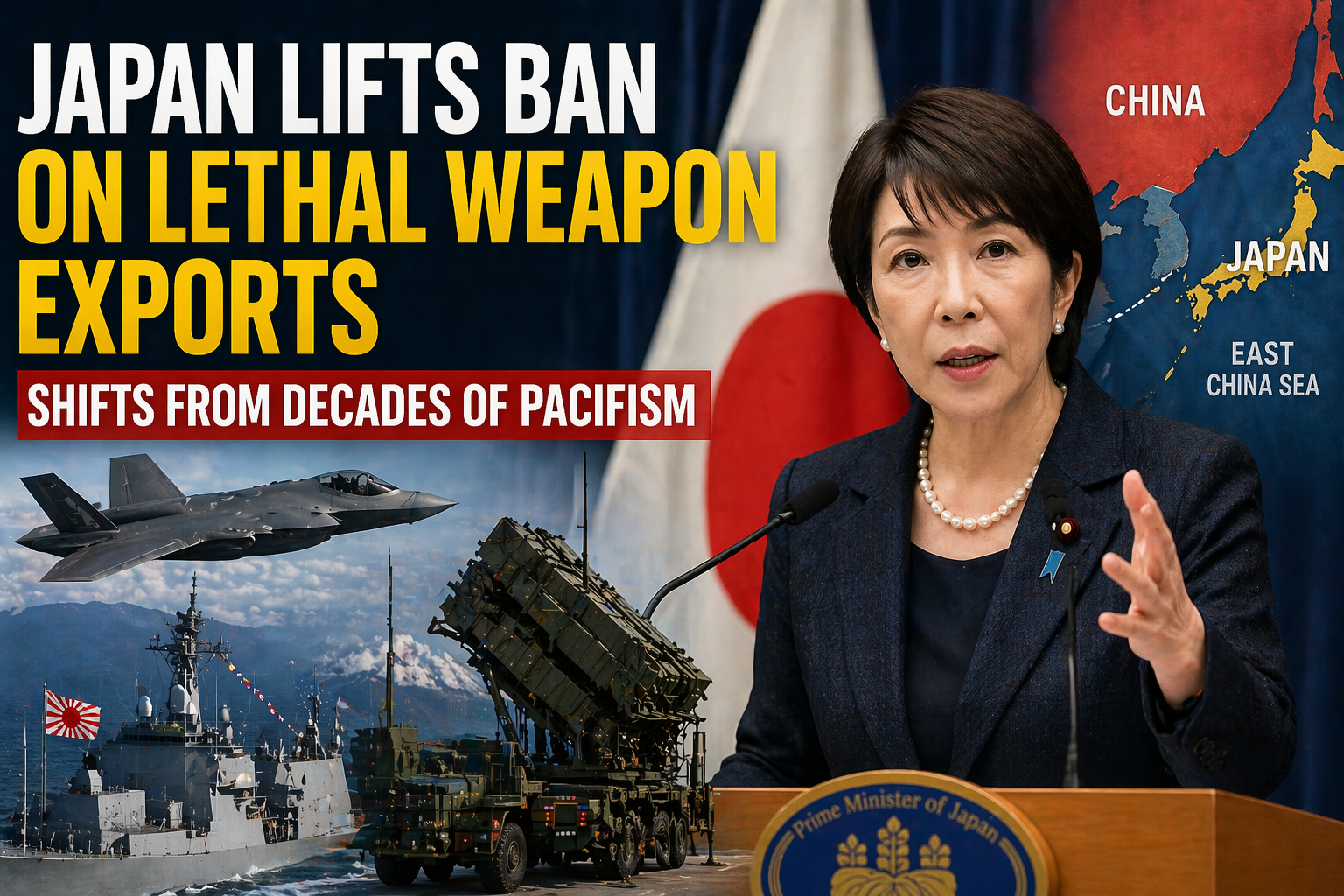
In a landmark policy shift, Japan has lifted its long-standing ban on the export of lethal weapons, signaling a major transformation in its post-World War II pacifist stance. The move, announced by Prime Minister Sanae Takaichi, reflects Tokyo’s response to a rapidly evolving global security environment.
A Historic Policy Shift
For decades, Japan adhered to strict limits on defense exports under its pacifist constitution, focusing only on non-lethal equipment. However, the latest amendment to the “Three Principles on Transfer of Defence Equipment and Technology” now allows the export of a wide range of military hardware.
Prime Minister Takaichi emphasized that the change is necessary in today’s geopolitical climate, stating that “no single country can now protect its own peace and security alone.”
What Has Changed?
Previously, Japan restricted exports to five categories:
- Search and rescue
- Transportation
- Surveillance
- Warning systems
- Mine countermeasures
Under the revised policy, exports of all defense equipment are now, in principle, permitted, marking a dramatic expansion.
This could include:
- Fighter jets
- Missiles
- Warships
- Advanced defense systems
However, all exports will still be subject to government screening and strict controls, particularly regarding transfers to third-party nations.
Strategic Implications
The decision is widely seen as part of Japan’s broader effort to strengthen its defense posture and deepen security cooperation with allies, particularly the United States.
Initially, exports are expected to be limited to a group of 17 partner countries that already have defense agreements with Japan. This ensures a controlled rollout while maintaining oversight.
Regional Reactions and Concerns
The move is likely to raise concerns in China, which has frequently criticized Japan’s gradual shift toward remilitarization. Tensions in the East China Sea, particularly around disputed territories, could be further intensified by this development.
Beijing views Japan’s military normalization with suspicion, especially as regional rivalries continue to grow.
Balancing Pacifism and Security
Despite the significant policy change, Takaichi reaffirmed Japan’s commitment to peace, stating that the country remains dedicated to its post-war principles.
“There is absolutely no change in our commitment to being a peace-loving nation,” she said, underscoring that the new policy is intended for defensive and cooperative purposes rather than aggression.
A New Era for Japan’s Defense Policy
This decision marks one of the most consequential shifts in Japan’s defense strategy in decades. As global security dynamics evolve, Japan appears to be recalibrating its role—from a strictly pacifist nation to a more proactive player in international security.
The coming months will reveal how this policy is implemented and how it reshapes Japan’s relationships across the Indo-Pacific and beyond.