








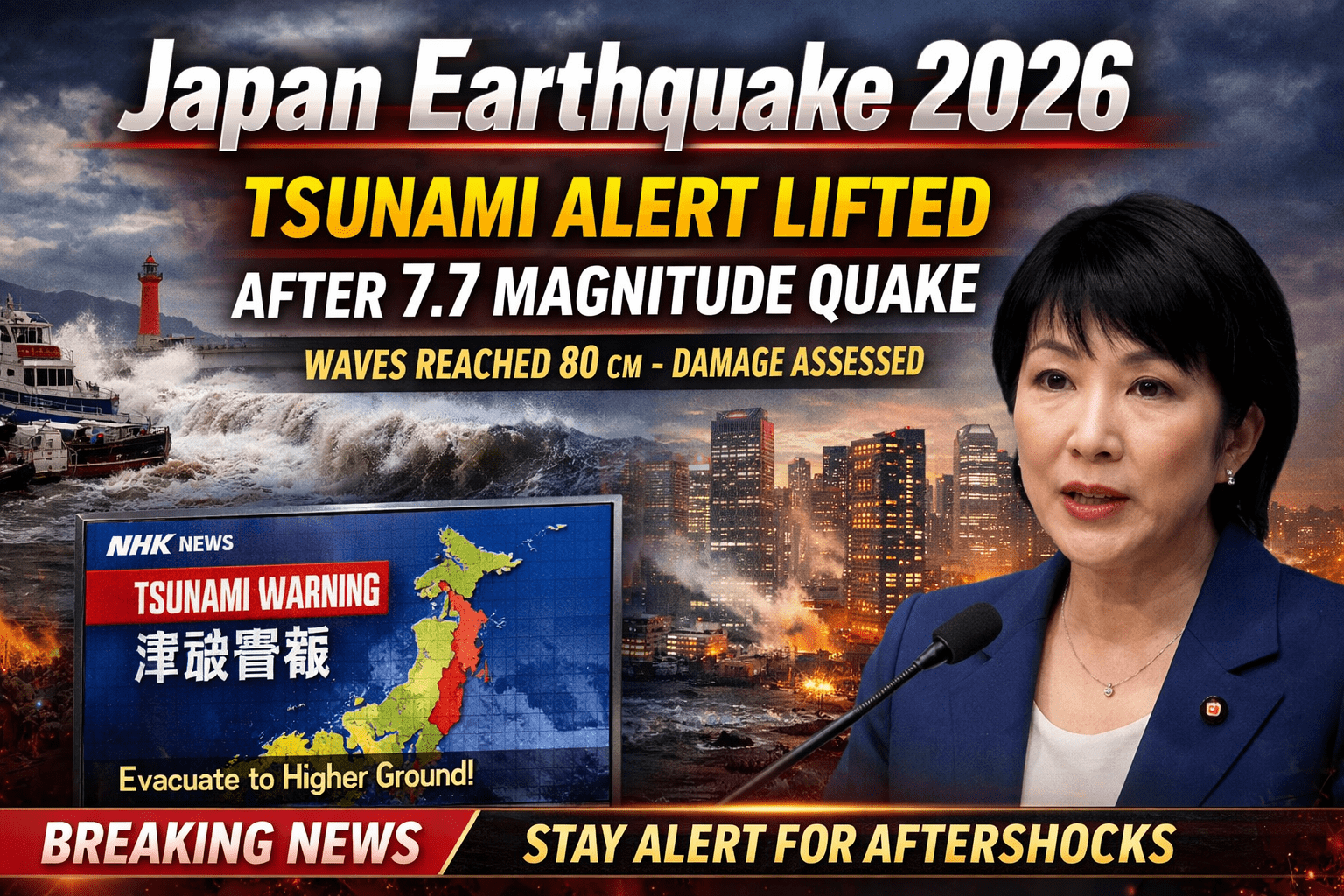
Japan has lifted a tsunami warning issued earlier in the day after a powerful magnitude 7.7 earthquake struck off its northern Pacific coast, triggering widespread concern but causing no immediate reports of major damage or casualties.
The earthquake hit at 4:53 PM local time (07:53 GMT) in waters off Iwate Prefecture, according to the Japan Meteorological Agency. The tremor was strong enough to be felt across a vast region, including Tokyo, located several hundred kilometers south of the epicenter.
Tsunami Warning Issued, Then Downgraded
Shortly after the quake, authorities issued a tsunami warning, cautioning that waves of up to 3 meters (10 feet) could strike coastal areas. Residents in affected regions were urged to evacuate immediately to higher ground.
Within two hours, tsunami waves measuring up to 80 centimeters (2 feet 7 inches) were recorded along parts of the northern coastline. As the situation stabilized, the warning was downgraded to an advisory and eventually lifted.
Officials emphasized that tsunami waves can arrive in multiple surges, warning residents not to return to low-lying areas until it was confirmed safe.
Government Activates Crisis Response
Japanese Prime Minister Sanae Takaichi announced that a crisis management team had been set up immediately after the quake.
“We are working to assess the full extent of the impact. Residents in affected areas should remain cautious and prioritize safety,” she said.
Authorities are still evaluating whether the earthquake caused structural damage or injuries, though early reports suggest minimal visible destruction. Live broadcasts from public broadcaster NHK showed normal conditions at several ports in Iwate, easing initial fears.
Japan’s Constant Earthquake Threat
Japan lies along the seismically active Pacific Ring of Fire, making it one of the most earthquake-prone countries in the world. The nation experiences roughly 1,500 earthquakes annually, accounting for nearly 18% of global seismic activity.
The latest tremor has revived memories of the catastrophic 2011 Tōhoku earthquake and tsunami, a magnitude 9.0 event that killed around 18,500 people and triggered the Fukushima nuclear disaster.
Ongoing Concerns Over Megaquake Risk
In recent years, scientists and authorities have raised alarms about the potential for a massive earthquake along the Nankai Trough, a major undersea fault line south of Japan. The government has issued rare “megaquake advisories” following increased seismic activity in 2024 and late 2025.
While Monday’s earthquake did not escalate into a major disaster, it serves as a stark reminder of Japan’s vulnerability to sudden and powerful natural events.
Situation Under Control, But Vigilance Urged
As of now, the tsunami alert has been lifted, and there are no confirmed reports of widespread destruction. However, officials continue to urge residents to remain alert for aftershocks, which are common following large quakes.
Japan’s swift response once again highlights the country’s advanced disaster preparedness systems, which play a critical role in minimizing damage and saving lives during such emergencies.